

It’s been a busy but ultimately successful month. Let me tell you some of the things I’ve been working on.
Over two years ago, I started working on an updated edition of Data Munging with Perl. I gave a lightning talk at the 2024 London Perl Workshop where I suggested it would be available by Christmas. That didn’t happen.
I gave an online presentation to the Toronto Perl Mongers in March 2025, where I suggested it would be available imminently. That didn’t happen.
But, finally, it is really happening. I have uploaded all of the required files to both Amazon and LeanPub and it will be available to buy on 21 November 2026.
You’ll be able to buy a paperback or an ebook from Amazon. You can already pre-order the ebook. I don’t know why they don’t allow readers to pre-order paperbacks, but I believe the paperback page will magically appear next Saturday.
You can already order the final “Work In Progress” version from LeanPub. And when the final version is published, you will get a free update to that version.
So what has changed in the 25 years since the first version was published? A lot!
Perl has changed. Many new features have been added since then. The code has been updated to use many modern features that make your code more readable. I’m particularly attached to subroutine signatures and postfix dereferencing.
CPAN has changed. A lot of the modules I discussed 25 years ago have gently passed into obsolescence. I’ve done a complete review of the modules I use and updated the code to use modern alternatives.
Data has changed. In 2001, I was able to write things like “HTML is becoming ubiquitous” with a straight face. I still cover HTML, but there is far less XML in the book, and its place has been taken by YAML and JSON. There is also far more detailed coverage of Unicode this time.
Writing the original edition took me about 15 months. Why has this version taken almost twice as long?
The truth is that it hasn’t really. Oh, yes, well over two years have elapsed since I started working on the update. But, honestly, most of the work has happened in the last six months or so. Before that, I occasionally poked at it a bit, but I was finding it quite hard to work on it for a sustained period of time. That changed when I got myself a new assistant.
That assistant was Claude.
But before you label the new edition as “AI slop”, let me explain what I mean.
I haven’t used Claude to actually write any of the book, but it has been an invaluable publishing assistant.
It carried out a review of the first edition and suggested places where updates were needed (both syntax and CPAN module choice).
It checked that the examples worked correctly on the Perl versions that I claimed they worked on.
It wrote and maintained a Makefile which contained tools to build the various output formats I needed and checks that ensured the EPUB was being created in a valid format.
On a couple of occasions, I ended up with an invalid EPUB. Claude deconstructed the file into its constituent parts, diagnosed the cause and implemented a fix.
It really helped in getting the formats correct. This ranged from writing CSS rules to developing Lua code that overrode Pandoc’s default mechanisms.
This is the first Perl School book that has an index. I’ve always thought that would be a long and arduous process. But Claude suggested a solution that took a couple of hours to implement.
It maintained a to-do list that drove the whole project.
There’s nothing there that I couldn’t have done myself. I don’t know Lua, and my knowledge of CSS for print is shaky at best—but I could have picked them up pretty quickly. Claude just made me so much more efficient.
I think there will be a blog post in the future which covers this in more detail.
The book will be available from next Saturday. I hope some of you find it interesting or useful. And if you do, I hope you’ll leave a review on Amazon and tell your colleagues.
Why publish it next Saturday? I hear you ask, why not immediately? Well, I’m glad you asked.
London Perl Workshop
The London Perl Workshop is next Saturday. And I thought I’d give the book a bit of a launch by making it available on the same day. Some of you might remember that Mohammad’s Design Patterns in Modern Perl was published on the day of last year’s LPW. Maybe we’ll make it an annual tradition that there’s a new Perl School book published at every LPW.
As well as launching the book, I’ll be giving two unrelated talks on the day:
The Right Level of Abstraction: Standing on the Shoulders of CPAN (10:40)
This is based on a couple of blog posts I wrote earlier in the year. I’ll be explaining why choosing the appropriate level of abstraction is an important skill for all programmers and explaining some decisions I’ve made on my Line of Succession project.Blogging about Perl using GitHub Pages (11:20)
It’s always a good idea to get more people blogging about the work they’re doing with Perl. And GitHub Pages is a great way to get a blog up and running very quickly.
This is a practical workshop. If you want to play along, bring a laptop and a GitHub account.
I should probably also think about giving a lightning talk to launch the book.
I have ordered some copies of the book, which I will hopefully have with me on the day. If you see me lugging a huge box of books around, please make my load a little lighter and buy one from me! Amazon is currently telling me they’ll arrive two days late (on the 23rd), but I think they’re being pessimistic. I guess we’ll see.
A couple of other projects
But those aren’t the only things I’ve been working on since I last wrote. Here are a few other things I’ve spent some time on.
Line of Succession prints
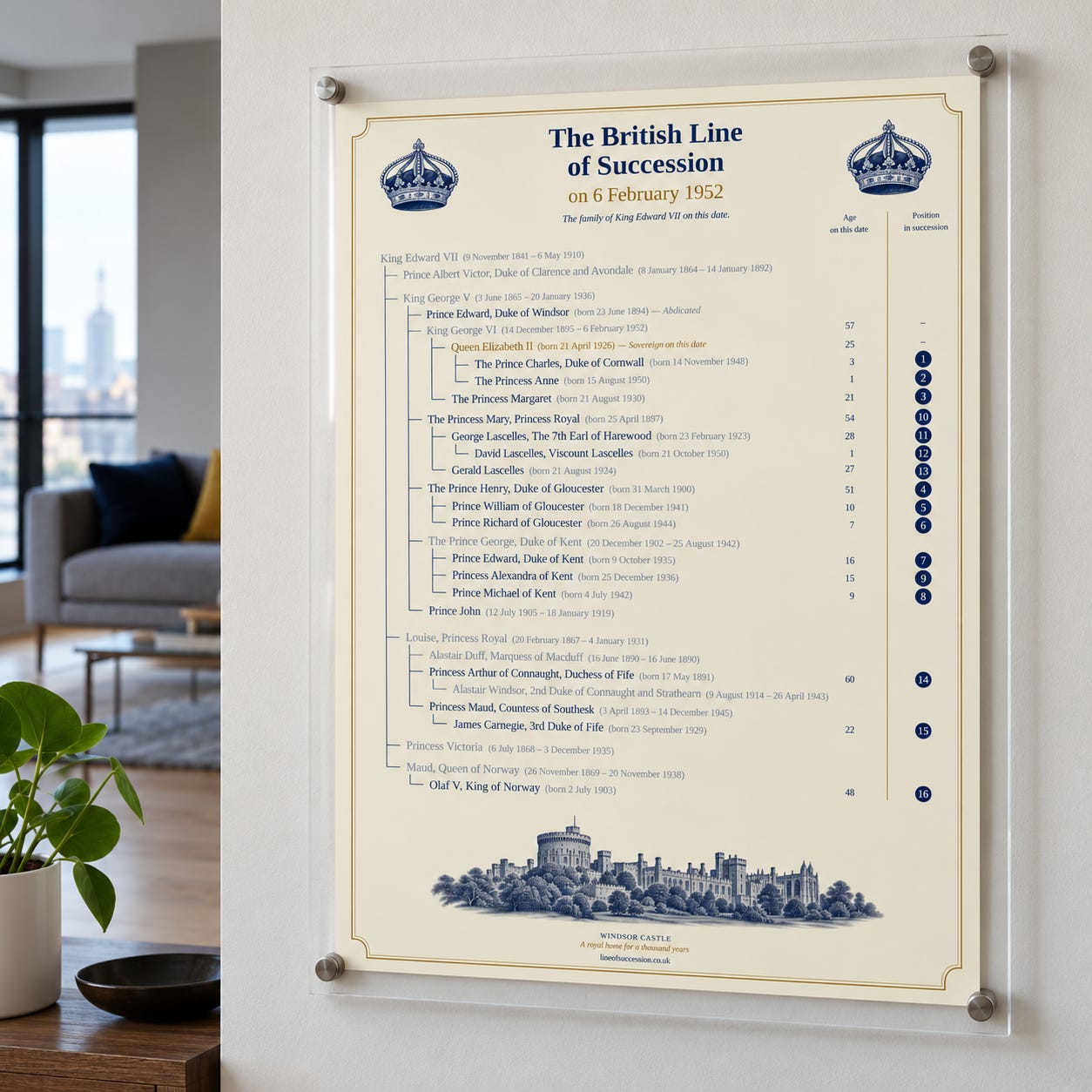
Long-time readers will know that my Line of Succession site is one of my oldest projects (here I am giving a talk about it in 2018). Although it’s a project I really enjoy working on, it doesn’t make me any money. Of course, that’s not completely necessary (it costs almost nothing to run), but given that it’s my most frequently-visited site, it would be good to make a little money from it.
And, last month, I came up with a plan that I think could work. The image above shows a customisable print that I’ll be selling from the site soon. You just pick a date (maybe a royal date that means something to you, or a wedding anniversary or something like that) and we’ll generate an A3 print of the line of succession on that date—which we’ll sell you at a price I haven’t quite worked out yet. I’m sure that most of my readers are far too call to put that on their wall, but I’m equally sure that you all know someone who would love it!
Feel free to take a closer look. Or try it out on a date that’s important to you.
I say I came up with the idea last month. That’s not really true. I implemented it last month, but it’s an idea I’ve been thinking about since about 2020. It’s another example of a project that I kept putting off because it would involve some hard thinking (to get the placement right in all circumstances) but having help from an LLM meant I got a prototype up and running in a couple of hours.
I’ve found a print-on-demand supplier and the samples I ordered looked really good. So once all the LPW/Data Munging work is out of the way, I’ll concentrate on getting that live. Hopefully in time for hundreds of people to buy them as Christmas presents.
Clapham Shop Fronts
I’m sure that Clapham is far from unique in the fact that its high street is in a state of constant flux. It’s really hard to make a success of a high street business in this economic environment and we often find a shop closing down, only to be replaced with something new a few weeks later. And the cycle repeats.
A couple of months ago I found myself walking down Clapham High Street (something I do most days) and realised I couldn’t remember what used to be in a building that had just turned into a coffee shop. I know that I can often get that information from Google StreetView. But you can’t control how frequently those photos are taken and shops often change so quickly that it’s easy for one to be missed.
So that’s what Clapham Shop Fronts is trying to address. I’m hoping that, over time, it will build into a valuable record of Clapham shops, past and present.
It gives me a closer connection to my local environment. And, perhaps more importantly, it gives me something to do when I’m on my morning walk down the high street.
Talking about MCPs
Going back, briefly, to the Line of Succession. Of all of my projects, it seemed like the most obvious one that might benefit from having an MCP endpoint. MCP is the “Model Context Protocol” that web applications can provide in order to make their data available to AI tools. So I wrote one (with help from ChatGPT). This was back in May, so I’ve already mentioned the blog post I wrote at the time.
Soon after that, Gabor got in touch and asked if I would be interested in giving a talk on the subject as part of his Code Maven talk series. I agreed and gave the talk about three weeks ago.
You can access the slides and video on my talks site.
So, yes, it’s been a pretty productive few weeks. That might explain why I’m so tired.
I hope to see some of you at the London Perl Workshop next weekend.
And please buy the book :-)
Cheers,
Dave…