
At the end of 2019, I quit my job.
That probably needs a little context.
For most of my career, I’d been a freelance software developer. By 2018, I was a reasonably well-known Perl contractor and had worked for most of the companies in London that employed significant numbers of Perl programmers.
That year, I started a contract at FairFX (now called Equals Money). About a year later, the company decided to reduce its reliance on contractors. But rather than getting rid of me, they offered me a permanent job as a staff engineer.
I accepted.
About six months later, I realised that permanent employment really wasn’t for me.
So I resigned.
Fortunately, I had enough savings that I didn’t need to find another contract immediately. Instead, I decided to give myself a year to see whether I could turn one of the many ideas rattling around my head into a business that could support me.
I called it my 2020 Vision.
The plan was simple. I’d spend a month on each idea. At the end of the month, I’d move on to the next one. Presumably, at some point, one of them would show enough promise that I’d concentrate on it.
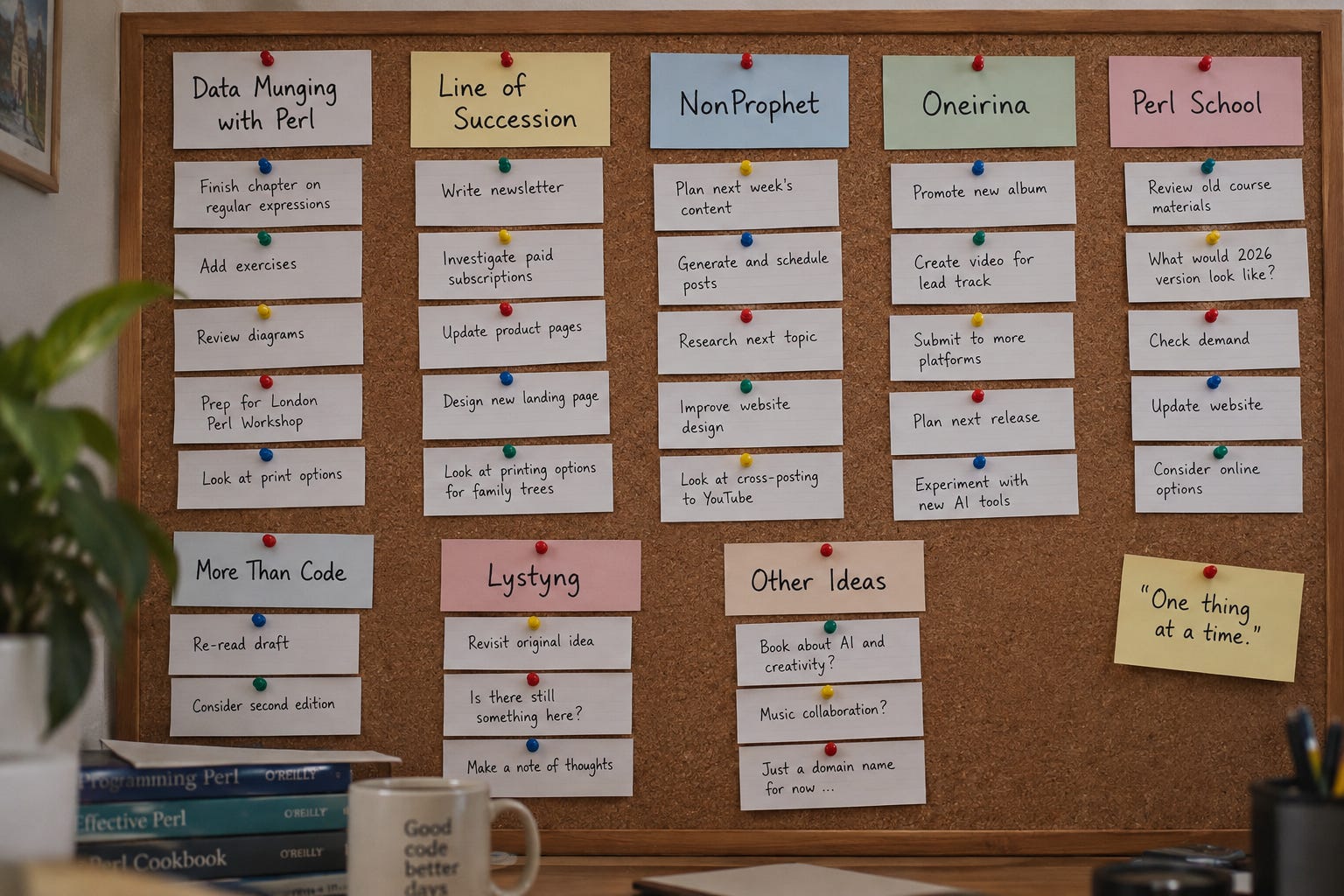
January was the Line of Succession. I’d been running a rather rudimentary version of the site for years, so I spent the month turning it into something more professional and started trying to find an audience for it.
February was Lystyng, an idea for a social network based around people sharing lists. That never got very far, although I still occasionally think there’s something in the idea.
March was More Than Code, a book about the parts of being a software developer that aren’t actually writing software.
And around this time, I started a newsletter to document the experiment.
I called it One Thing at a Time.
You can probably guess what happened next.
It was March 2020.
For no particularly rational reason (I was working at home anyway and had enough money to live on) the arrival of Covid completely derailed the experiment. The remainder of 2020 disappeared into a sea of confusion.
Since then, I’ve been slowly rebuilding.
I’ve taken more contracts. I’ve even had another attempt at permanent employment (I lasted four months that time). And, all the while, I’ve continued to collect projects.
Lots of projects. You will have seen me mention some of them in this newsletter.
There are books. Websites. Newsletters. Software projects. Music projects. Some are finished. Some are nearly finished. Some are little more than domain names and vague intentions. Some have been sitting untouched for years before suddenly springing back to life.
And this creates a problem.
The obvious solution is right there in the name of this newsletter: one thing at a time.
Pick the most important project. Work on it until it’s finished. Then pick another one.
It’s excellent advice.
And I seem completely incapable of following it.
The Three Ps
A few years ago, a friend suggested a different way of thinking about my collection of projects. I’ve refined the idea over time into what I now call the Three Ps.
They are Profit, Practice and Profile.
Profit is the obvious one. Does this project make money? Or, perhaps more importantly, is there a plausible route by which it might eventually make money?
Client work is almost entirely Profit. Other projects might not make much money today, but could conceivably grow into useful sources of income.
Practice is about developing skills.
I’m a software developer, but the list of things I want to be better at extends far beyond writing code. Writing, publishing, design, marketing, AI, video, audio, data analysis—there are always new things to learn.
A project can justify some of my time simply because working on it teaches me something useful.
And then there’s Profile.
Some projects put my work in front of people. They build an audience, enhance my reputation or introduce me to people I wouldn’t otherwise encounter.
That has value too. Sometimes it’s eventually financial value. Sometimes it leads to opportunities that I couldn’t possibly have predicted when I started the project.
The important thing is that these aren’t three separate buckets.
A good project might hit two of the Ps. A really good one might hit all three.
And a project that hits one of them particularly strongly can still be worth doing.
But there’s also an interesting question to ask about a project that doesn’t hit any of them.
Why am I spending time on this?
Perhaps there’s a good answer. This isn’t intended to be an algorithm for running my life. I’m allowed to do things just because I enjoy them.
But it’s a useful question.
One day at a time
Over the last couple of weeks, I’ve started using the Three Ps more deliberately to plan my working time.
And it’s made me reconsider what I meant when I called this newsletter One Thing at a Time.
Back in 2020, the unit of “at a time” was a month.
January was Line of Succession. February was Lystyng. March was More Than Code.
The theory was that I’d concentrate exclusively on one project for a month before moving on to something else.
I don’t think that works for me.
What seems to work rather better is making the unit a day.
I can have several active projects. But that doesn’t mean they all need to be competing for my attention simultaneously.
Today can be a book day.
Tomorrow can be a Line of Succession day.
Another day can be devoted to promoting some music I’ve released.
Another can be spent experimenting with some new technology.
The Three Ps help me decide which projects deserve those days. And once I’ve decided what a particular day is for, One Thing at a Time takes over.
There’s a surprisingly important psychological difference here.
If I know that a project has Thursday allocated to it, I don’t need to fiddle with it on Tuesday. I can concentrate on Tuesday’s project because I know the other thing’s turn is coming.
I’m still experimenting with this. I’m sure the system will change again.
But I increasingly think my problem was never that I had too many projects.
The problem was having too many projects asking for my attention at the same time.
Putting it into practice
This all sounds suspiciously like the kind of productivity system that is much more fun to devise than it is to actually use.
So I’ve started using it.
For the last couple of weeks, I’ve been looking across my collection of projects, thinking about how they score against the Three Ps, and giving particular projects whole days in my calendar.
Some of the choices are obvious.
Data Munging with Perl is the second edition of a book I first published more than twenty years ago. It’s currently about 80% complete and I want paperback copies available for the London Perl Workshop at the end of November. That’s primarily Profit (it’s a product I can sell), but writing it also keeps my Perl knowledge sharp and raises my profile in a community where I’ve been working for decades. So there’s a bit of all three Ps there.
Line of Succession is an even more interesting example. It’s the survivor from the original 2020 Vision experiment. It already has a small audience, and recently I’ve been looking seriously at ways to turn that audience into income — paid newsletter subscriptions, books and personalised printed family trees of the royal succession. That’s Profit and Profile, with plenty of Practice thrown in as I experiment with publishing and marketing.
NonProphet is a much newer project: a website and set of social media accounts looking critically at claims that Old Testament passages predicted events in the life of Jesus. At the moment, it’s mostly Practice and Profile. It’s an excuse to experiment with automated content production and social media formats while writing about something I find interesting. I don’t currently have much of a plan for making money from it.
Then there’s Oneirina, my increasingly elaborate experiment in creating and releasing music with generative AI. An album came out last week, which means there’s now the entirely different problem of working out how to persuade people to listen to it. That’s mostly Practice and Profile too: I’m learning an enormous amount about music distribution, promotion, video and AI tools.
Perl School is my small publishing house, specialising in books about Perl and related technologies. Next week I want to devote a day to looking at the business as a whole: the books already published, the ones in development, and what I can do to turn it into a more substantial source of income. It's an interesting Three Ps project because publishing obviously has potential for Profit, producing books involves plenty of Practice, and every new title helps build both the Perl School brand and my own Profile.
There are plenty of other projects too, at various stages of completion.
That’s one of the useful things about the Three Ps. It doesn’t tell me what to work on. It gives me a way to interrogate why I think something deserves my time.
2020 Vision, revisited
There’s one other thing I’ve noticed while thinking about all of this.
My 2020 Vision didn’t entirely fail.
The first project I worked on, back in January 2020, was the Line of Succession.
It’s still running.
In fact, over the last few weeks I’ve been putting more effort into it than I have for years: improving the site, building the newsletter and experimenting with ways that it might actually generate some useful income.
Six and a half years after I gave it its allotted month, I’m still finding out what that project might become.
Perhaps that was the real problem with 2020 Vision.
I assumed that a month would tell me whether an idea was worth pursuing.
But projects don’t necessarily work like that.
They can go quiet. They can change direction. Something that starts as Practice can become Profile. Something that builds Profile can eventually turn into Profit. An idea you abandon can suddenly become interesting again years later.
So perhaps I’m still following my 2020 Vision after all.
I’ve just stopped expecting it to run to a timetable.
And I’m still doing one thing at a time.
I’ve simply changed what I mean by “a time”.
How do you decide what to spend your time on? Could this framework be useful to you?
Until next time,
Cheers,
Dave…
P.S. There’s a certain irony in writing an entire post about Profit, Practice and Profile while giving you no way to contribute to the first of those.
So, as part of today’s experiment, I’ve switched on paid subscriptions for One Thing at a Time.
Nothing else is changing. I have no plans to put posts behind a paywall. If you enjoy reading this for free, please carry on doing exactly that. But if you particularly enjoy the newsletter, find some of my experiments useful, or simply want to support what I’m doing, you now have that option.
And here’s the interesting bit. Before I’d even switched payments on, two people had already pledged to become paid subscribers.
So One Thing at a Time became a revenue-generating project the moment I pressed the button.
I guess we can put a tick next to Profit.